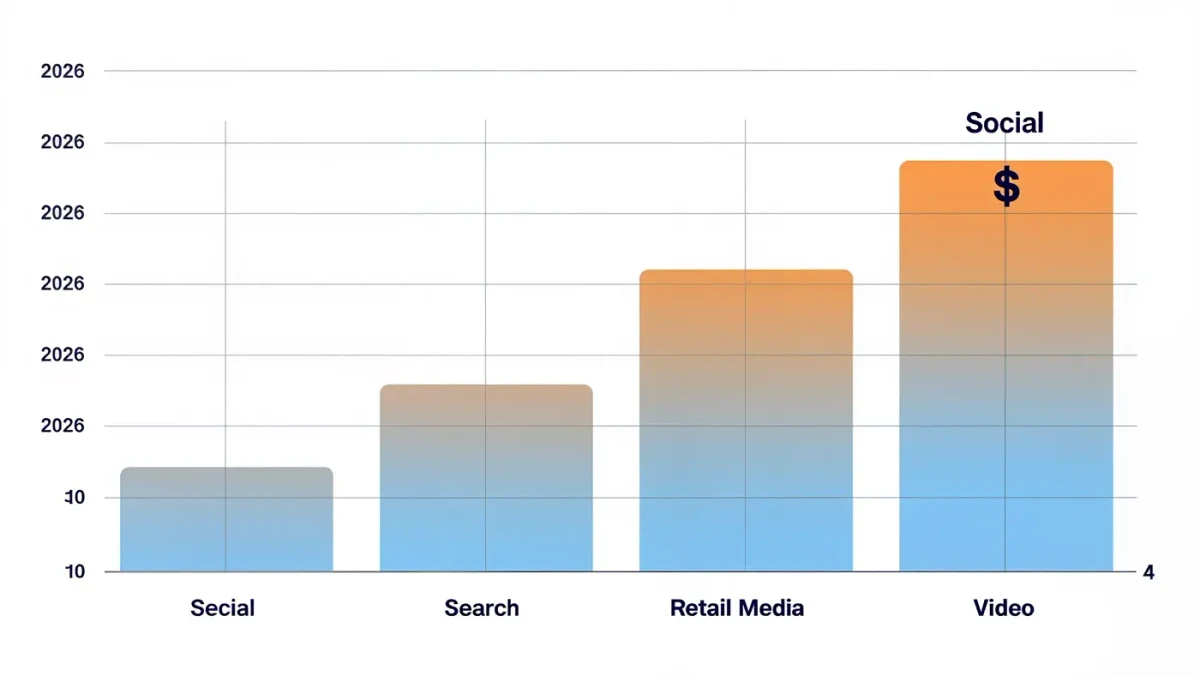
Per the Advertising Association and WARC, April 30, 2026: UK advertising investment grew 9.3% year on year in the first quarter of 2026, reaching £11.7 billion — 1.7 percentage points ahead of the forecast published in April. The full-year projection now stands at 8.2% growth to £50.5 billion. Beating a forecast made weeks earlier is itself the story: the market is running hotter than the analysts who track it monthly expected.
Where the growth sits
The report attributes the quarter to double-digit increases in three channels — social media, retail media, and out-of-home. The pattern repeats what the IAB's US data showed for 2025: growth is not spread across the market, it is concentrated in channels that share three properties — attention measured in seconds not impressions, purchasing context built into the placement, and delivery increasingly automated by the platform's own AI.
- Social keeps absorbing budgets that once went to display, powered by creator content and shoppable formats.
- Retail media monetizes the last measurable moment before purchase, which is why grocers and marketplaces now sell ads the way broadcasters once did.
- OOH has quietly digitalized; programmatic screens give it the targeting and reporting vocabulary that traditional billboards never had.
Reading the report like an analyst
The AA/WARC series earns its authority through consistency — the same construction, updated on a schedule, with forecasts that can be checked against outcomes. That last property is rarer than it looks, and it is why a missed forecast matters. When actuals run ahead of projection by 1.7 points, the useful question is not "who was wrong" but "which assumptions broke": spending that was budgeted and released earlier than expected, pricing that rose faster than volume, or channels that grew beyond their model. The report's channel attribution — the double-digit trio carrying the quarter — is the beginning of that answer, not the end.
The disciplined habit is to track the forecast series, not the quarterly headlines. A single strong quarter in a cyclical market can be timing; two consecutive beats, with the full-year projection revised up alongside, is a trend with momentum. The 8.2% full-year figure is the number to hold the market to when Q2 and Q3 data land.
And when you quote the numbers, quote the construction: this is investment, not volume — a market can grow because advertisers bought more, or because the same attention cost more. Both years look identical in the topline and completely different in the planning.
What beating the forecast signals
Two readings. The benign one: demand is strong and confidence is real, so brands investing through uncertainty are gaining share. The sharper one: pricing. When a market beats its forecast, part of the surprise is usually inflation — advertisers paying more for the same attention. For planners, that means 2026 budget conversations should assume CPM deflation nowhere and negotiate channel mixes accordingly, rather than extrapolating last year's unit costs.
Where earned media sits in this
The expenditure report maps paid channels, but the same money shapes the earned environment. When social and retail media absorb the growth, the surfaces where audiences actually spend attention become more crowded and more expensive — which raises, not lowers, the relative value of coverage that cannot be bought outright. Earned placements in an attention-scarce market function as the arbitrage: credibility and reach that paid channels must bid for at rising auction prices.
The pressure runs the other way too. Clients whose paid budgets are being squeezed by unit-cost inflation look at PR's economics with fresh interest, but they also import procurement instincts — asking for measurement discipline closer to what paid channels deliver. PR teams that can report outcomes rather than activity are positioned for that conversation. Ones still reporting clip counts are about to meet a CFO's questions with a press-book.
The strategic synthesis is straightforward: in a market growing at 8-9% on price and attention concentration, the combination that works is earned credibility amplified by precisely the paid channels where the growth sits. Neither alone keeps up.
The channels left behind
Growth concentrated in three channels means stagnation concentrated everywhere else, and the report's pattern implies its own losers' list. Channels that sell exposure without purchasing context, measurement or creator energy are competing for a shrinking share of a growing market — losing relative position even in a year when the total rose 9.3%. That is a slower crisis than decline: budgets exit gradually, through reallocation at planning season rather than through dramatic cuts.
For advertisers, the uncomfortable implication is that historical spend-weighting is now an active decision to under-invest where attention and measurement are moving. The audit question for any UK plan is simple: does our channel mix resemble the market's growth distribution at all, or does it resemble our 2019 org chart?
The transatlantic mirror
The UK figures land weeks after the IAB/PwC report put US digital ad revenue up 13.9% for 2025. Different markets, same shape: digital-first, social- and video-led, with AI-delivered formats taking a growing slice. For any marketer working across both, the planning implication is blunt — the growth channels are the same on both sides of the Atlantic, and so is the tightening auction for them.
What to do
Re-baseline your UK channel budgets against the 8.2% full-year projection rather than Q1 momentum, audit whether your social and retail media presence matches where the market is actually adding spend, and treat rising unit costs as a creative problem — the answer to a pricier impression is a better one.