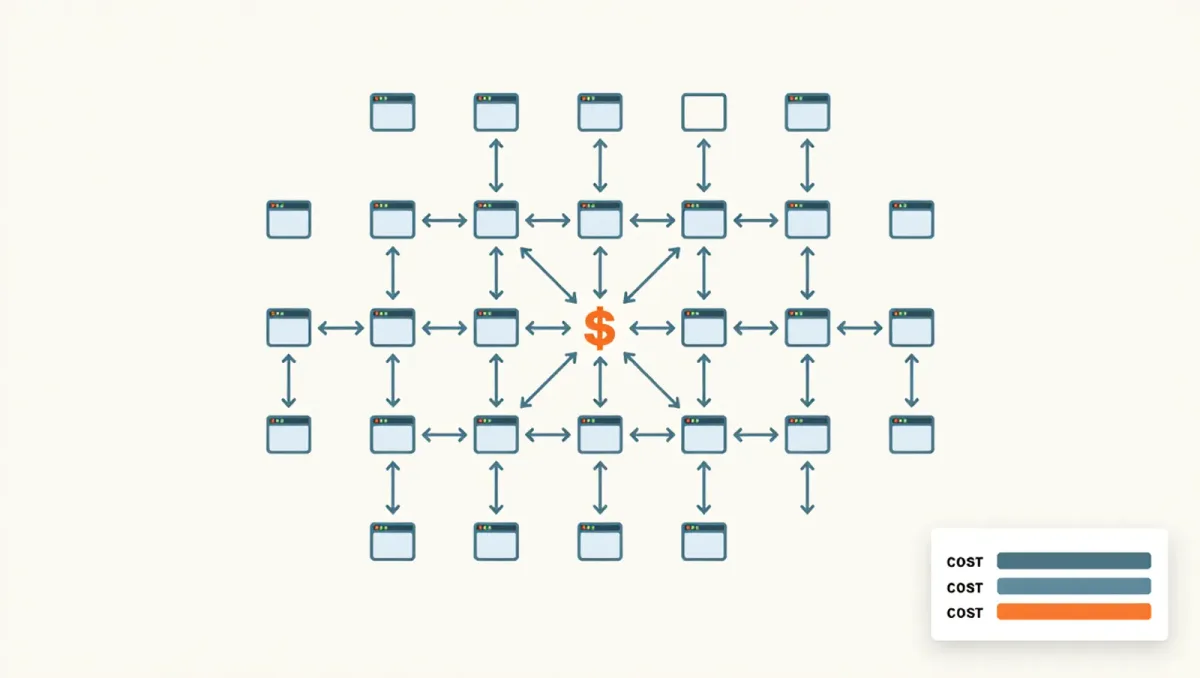
A link farm is not a metaphor. It is infrastructure: hundreds or thousands of sites that exist to link to each other and to paying clients, with no human audience at any point in the loop. The economics are what keep it alive, and the economics are more fragile than the sellers admit.
The cost stack of a farm
Run the numbers the way an operator does. A mid-size farm of 500 sites breaks down roughly like this:
| Line item | Monthly cost |
|---|---|
| Domains (amortized, $8–$15/year each, many expired) | $500–$800 |
| Hosting (bulk/shared plans, dozens of sites per server) | $200–$600 |
| Content (AI-generated or spun, near-zero marginal cost) | $100–$500 |
| Indexing tricks and tooling | $100–$300 |
Call it $1,000–$2,200 a month to run a farm that can sell 100–300 links at $50–$400 each. That is a gross margin north of 90% — which is exactly why the market persists despite every penalty cycle Google has run against it.
Where the content comes from
A farm's pages need to exist, not to be read. The documented supply chain: scraped articles run through "spinning" software, auto-translated text, and now large-scale AI generation. The result is technically unique content that satisfies old-school duplication checks while containing nothing. Google's spam policies on scaled content abuse address exactly this: content created for search engines rather than people, whatever tool produced it.
Why the links "work" — briefly
The farm's product is PageRank-shaped authority. Links from sites with any history — especially expired domains that once were legitimate — pass signals that rank cheap keywords for weeks or months. The window is the business model: by the time search engines classify the network and neutralize its links, the client's invoice is long since paid, and sellers have moved to new domains. Buyers are effectively renting rankings on a decaying asset and paying as if they bought one.
How farms are detected
Search engines and independent analysts converge on the same signatures:
- Outbound link profiles. Sites linking out to dozens of unrelated commercial pages — casinos, CBD, SaaS, legal — in footers, author bios, and inserted paragraphs.
- Host and registration clustering. Shared IP ranges, registrar patterns, and analytics IDs revealing one operator behind "independent" sites.
- Content entropy. Templated layouts, article cadence, and internal linking graphs that no human editorial operation produces.
- No audience. Zero direct traffic, no returning visitors, no engagement — the defining trait, visible in any traffic tool.
Google's link spam updates and its SpamBrain systems operationalize these signals at scale, and the company's spam policy on link spam states the position plainly: links bought, exchanged, or generated to manipulate rankings violate the policies, and the links may be neutralized — with the buyer's site exposed to manual actions.
Who still buys, and why
The customer profile is rational in a narrow way: an agency with a quarterly deliverable of "40 referring domains" can hit the number with farm links for a few thousand dollars, invoice it, and be gone before devaluation lands. The model depends on clients who measure counts instead of outcomes. Every buyer checking whether linked pages have real human traffic — and whether those links still pass value ninety days later — erodes the model at its only load-bearing point.
A farm listing, read as a primary source
The sellers' own sales materials are the best primary documents for understanding the product. Representative link-seller sheets — the ones circulated in agency communities and resold as "inventory lists" — include fields no legitimate publisher would ever enumerate: authority score, outbound-link cap ("max 3 per page or anchors lose value"), indexing guarantee windows ("indexed in 3-7 days or replaced"), and bulk tiers (50-link minimums). Every field describes a manufacturing process, not a publication. The "replaced if not indexed" clause is the most telling: it concedes that some proportion of the network's pages are already excluded from search — a condition real publishers cannot have, because their pages are their product. The volume tiers reveal the margin structure equally plainly: at 50-link minimums and per-link prices, the operator's revenue per site per month exceeds any plausible advertising revenue the site could earn from readers, which is arithmetic proof that the site has no readers. Buyers who receive such a sheet should read it as a confession in tabular form — the operator has documented, in the ordinary language of their trade, every property that policy names as spam.
How to protect yourself
- Audit traffic, not domains. Before buying any placement, check the delivering site's organic traffic in an independent tool. A "DR 55" site with 200 monthly visits is a farm leaf node.
- Check the outbound profile. Review the site's existing links: dozens of unrelated commercial anchors means the farm has already sold to your competitors.
- Sample the content. Read three articles. Spun or generated filler signals scaled content abuse — and a site living on borrowed time.
- Price-test the offer. Real editorial placements cost hundreds to thousands because they require human work. $75 "guest posts" on "DA 60" sites are a farm price.
- Track link decay. Log your referring domains monthly; farms lose links in batches as networks die. Batch loss is a fingerprint of bought links.
- Read the policy. Google's link spam policy is explicit that purchased links violate its rules — a documented basis for manual actions against your site, not just the seller's.
The farm's ledger has three parties. The operator wins every month. The client pays rent on rankings that decay. The search engine repossesses. Only one of the three knows it is gambling.