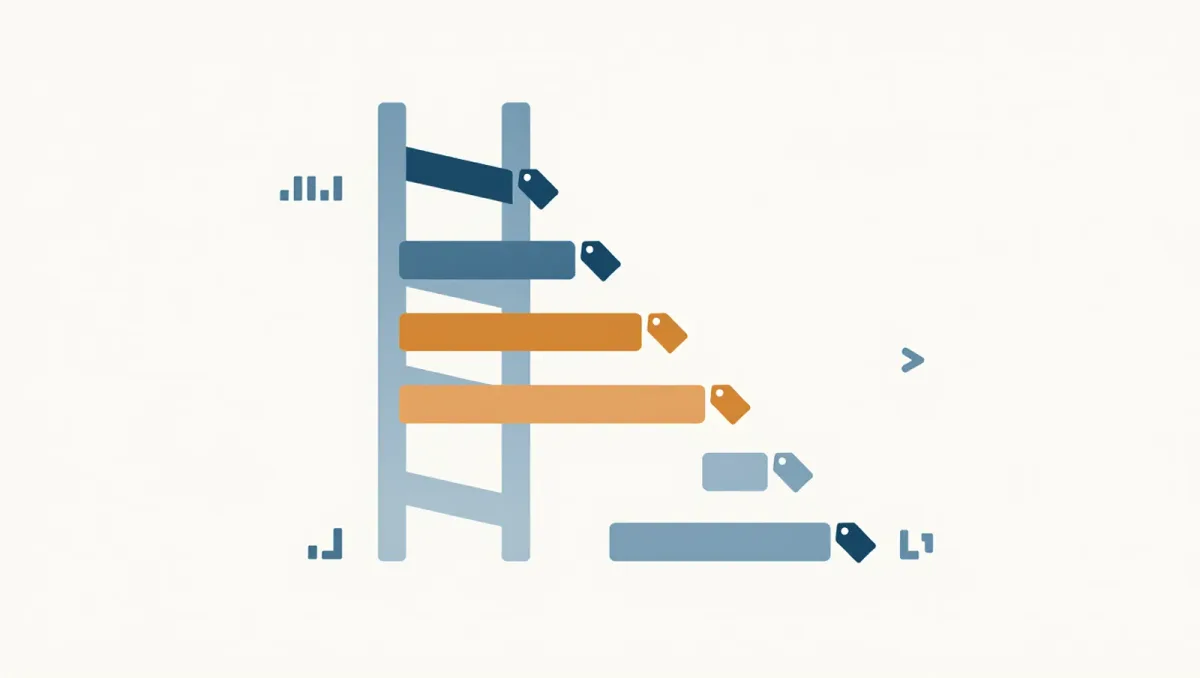
Every dollar spent on links lands somewhere on a ladder with four rungs, and each rung sells a different thing wearing the same name. Knowing which rung your invoice came from — and what fraction of your money reaches the thing you imagined — is the entire financial literacy of the link market. Herewith, the ladder, top to bottom, with the money trail at every level.
Rung 1: Earned editorial ($0 in fees; $10,000–$25,000 per campaign in effort)
A journalist chose to cite you. No fee changes hands; the campaign cost buys research, assets, and pitching. What you pay for: story development and relationships. What you get: permanent, policy-clean citations on publications with real readers, plus the asset that keeps earning. What nobody tells you: the per-link price is the highest on the ladder at delivery and the lowest within two years, because these links are the only ones that compound.
Rung 2: Legitimate sponsored ($300–$5,000 per placement, disclosed)
A real publication sells a clearly labeled sponsored article or newsletter placement. What you pay for: audience access and brand association, priced as advertising. What you do not get: ranking value — rel="sponsored" and the FTC-style disclosure strip the SEO utility, which is the point. The honest way to know you are on rung 2 is that the seller insists on the label. The scam version of rung 2 is rung 4 wearing its clothes: same words, no disclosure, no audience.
Rung 3: The gray guest post ($150–$900 per placement, undisclosed)
A real-ish site sells your article into its feed without labeling the payment. What you pay for: a link that passes value today. Where the money goes: typically 30–50% to the site owner, 15–30% to a marketplace, the rest to an agency margin — against content costs of $10–$50. What you get: a link with a documented decay schedule. It is a policy violation on the seller's side, scheme participation on yours, and its survival depends on nothing you control. This rung is the market's volume center precisely because it is priced for buyers who want rung 1's effects at rung 4's indifference to rules.
Rung 4: Network inventory ($50–$500 per link, fabricated)
PBN nodes, farm leaf sites, niche-edit brokers, hacked injections. What you pay for: a link from a site that exists to sell links, at gross margins above 90%. What you get: an asset that dies in batches when the network is classified, with your domain carrying the policy exposure. Where the money goes: domains, hosting, generated content — and margin. The rung's entire pricing power comes from authority scores that were themselves built on the same inventory. It is the market selling its own exhaust at retail.
The spread between rungs is information
Price anomalies mark which rung is pretending to be another:
- Rung 3 priced like rung 2 ("$800 guest post, DR 55, no disclosure") — you are paying for undisclosed value, which means paying for decay.
- Rung 4 priced like rung 3 ("niche edit, real site, $350") — check the site's outbound profile and IP neighbors; the "real site" has thirty siblings.
- Rung 1 offered at rung 4 prices ("guaranteed editorial, $150") — the word "guaranteed" has already told you the rung.
What each rung survives
Every Google spam wave is a rung audit. Rung 1 persists by definition — editorial choices are what the classifiers treat as signal. Rung 2 persists as a legal ad product with zero SEO value. Rung 3 decays in waves tied to marketplace and site-owner cleanups. Rung 4 dies in batches, on someone else's schedule, taking the quarter's rankings with it. Buyers who model survival instead of acquisition price these rungs correctly for the first time.
Reading any link invoice in ninety seconds
Condense the ladder into a working protocol. Line one: what is the deliverable, verbatim? Words like "editorial placement," "feature," and "coverage" imply rung 1; "guest post," "insertion," and "niche edit" confess rungs 3–4. Line two: is disclosure named? Any deliverable requiring non-disclosure to function has told you it violates policy and, in consumer-law terms, misleads readers — there is no neutral version of that sentence. Line three: what does the publisher receive? Divide your invoice by the publisher's fee; the remainder is intermediary margin, and anything above 50% means you are buying logistics around a link, not a link. Line four: what is the survival commitment? Rungs 3–4 answer in replacements and reruns; rung 1 answers in permanence because permanence is free at that rung. Line five, the decisive one: who chose to link? An editor, a budget line, or a script — every invoice answers this question somewhere in its vocabulary, if you read for it. Five questions, ninety seconds, and the market's pricing fog condenses into one of four rows. Founders who run the protocol before signing rarely need the refunds, the chargebacks, or the cautionary write-ups.
How to protect yourself
- Classify before buying. For every offer, name the rung: was this link chosen by an editor, sold with disclosure, sold without disclosure, or manufactured? The classification determines everything else.
- Trace the take. Ask what the site owner receives versus your invoice. A 70%+ intermediary margin means you are buying logistics, not publishing.
- Demand the survival history. Any seller should answer: what share of links from the past 24 months is still live and passing value? Rungs 3 and 4 cannot answer honestly; the silence is the data.
- Buy rung 1 deliberately. Budget for assets and pitching as capital expenditure, judge on survived-link velocity, and refuse to let the program be measured in purchased units.
- Use rung 2 as advertising, honestly labeled. Audience and brand association are real products. Just never book them as links.
- Never book rungs 3–4. Not because policy paperwork scares you, but because their economics only work if you measure acquisition instead of survival — and that measurement error is the most expensive thing on this page.
The ladder has one other property worth knowing: it is one-way in accounting. Spend on rung 1 creates an asset on your balance sheet. Spend on rungs 3 and 4 creates a liability wearing a link costume. Read every invoice twice: once for what it charges, once for which rung it quietly assumes you cannot tell apart.