Per FTC announcements, April 2026: the agency filed an administrative complaint and proposed consent order against TruHeight, a maker of height-growth supplements for children and teenagers, and two of its principals. It is the first case the FTC has brought under its Consumer Review Rule — the 2024 ban on fake reviews and testimonials — stacking review-deception counts on top of allegations of deceptive and unsubstantiated advertising claims. Per the FTC, the proposed order carried a judgment reported at around $4 million, with a smaller suspension amount due.
Why this case is the template
The warning letters the FTC sent to ten companies in December 2025 established notice. TruHeight establishes structure: the agency did not prosecute fake reviews in isolation, it combined them with the underlying product claims. That combination is the part brand and marketing teams should study. A review fraud count alone is embarrassing; combined with unsubstantiated claims about what a product does, it becomes a portrait of a marketing operation, and the penalty is priced accordingly.
The defendant profile matters too. This is not a platform, a review farm, or an agency. It is a consumer brand with a plausible-sounding product, real retail distribution and a testimonials page. That is the enforcement surface now: ordinary brands whose growth marketing crossed lines the rule now names explicitly.
The stacking strategy also changes how defense and compliance should think about exposure. Under general deception doctrine, an ad claim problem was usually one case. Under the rule, the same fact pattern fragments into a claim count plus a review count plus a suppression count — and each review can be its own violation at statutory rates. The multiplication is the deterrent. Legal teams pricing settlement scenarios now have to model testimonial inventory as an asset with negative regulatory value, which is a genuinely new calculation.
What counts as a violation
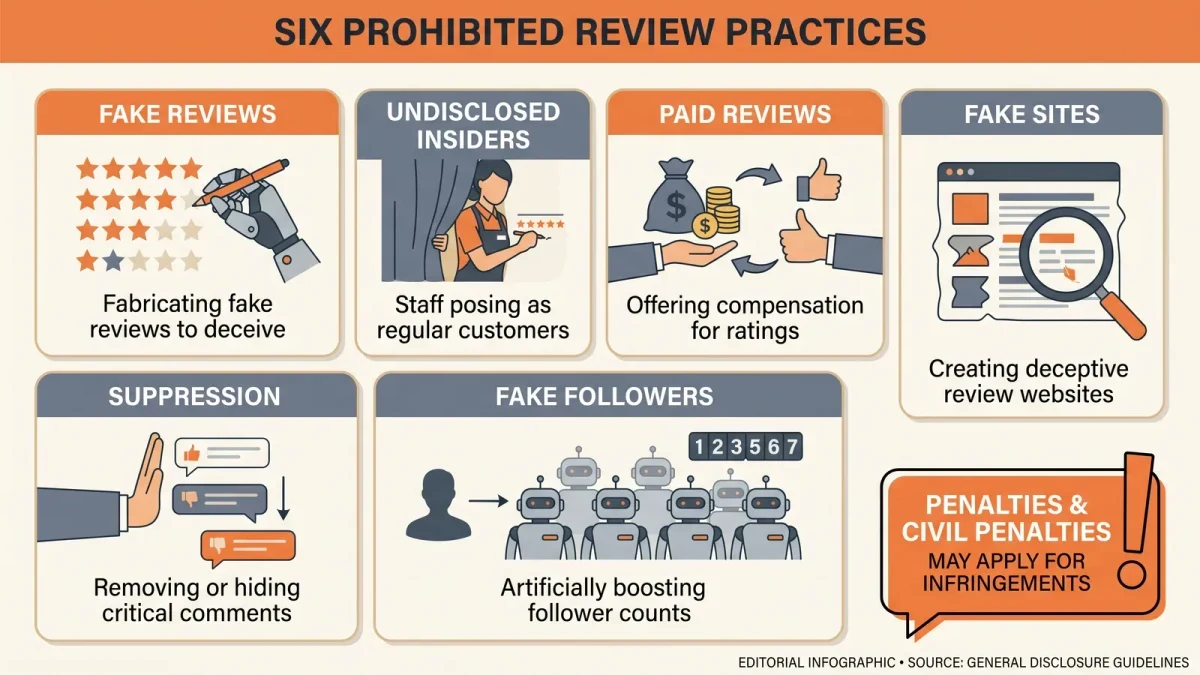
Under the rule, the prohibited conduct includes fake or AI-generated reviews, insider reviews without disclosure, buying positive reviews, suppressing negative ones, and fake social media indicators. Civil penalty exposure runs to roughly $50,000-plus per violation, inflation-adjusted — which is why companies with large review volumes face exposure counted in millions, not thousands. The December letters put ten companies on notice; this complaint shows the FTC willing to convert that posture into a case with money attached.
It is worth being precise about what "fake" means here, because the rule is narrower than panic suggests and broader than comfort suggests. The target is misrepresentation of experience: a review attributed to a customer who never bought, a testimonial from a person who never used the product, an AI-written review with no human behind it. Genuine customers incentivized with disclosure, employees identified as employees, and critical reviews left alone are all outside the prohibited list. The compliance line is not "never touch reviews" — it is "every review must trace to a real, disclosed experience."
It also matters that the resolution is a consent order rather than litigated judgment. A consent order resolves this matter but functions industry-wide as an exhibit of what the agency considers provable. The described practices — testimonials tied to claims the business could not support — are common enough that every reader recognizes them from somewhere. Recognition is the deterrent mechanism: the case works not because TruHeight was unusual but because it was not.
The individual defendants
The inclusion of two principals in the complaint is the detail executives should not skip. Personal liability changes who attends compliance meetings. When only the company is exposed, review fraud is a cost of doing business that insurance and indemnities can absorb. When officers are named, it is a career event. The FTC has long used individual defendants to focus institutional attention in other areas; applying the technique to review deception signals that the agency considers the conduct serious, not technical.
For agencies and vendors, the implication is adjacent but real. Principals being named makes it harder for brands to claim they were misled by service providers — and easier for named principals to argue the vendors ran the playbook. Expect the supply chain of review manipulation to feature in whichever case comes second.
The industry reaction
Defense lawyers immediately flagged the predictable battleground: whether specific reviews cited in complaints actually fall within the rule's prohibitions, and how the agency proves a reviewer had no genuine experience with the product. Those challenges will shape the rule's boundaries over the next two years. But challenges take years, and consent orders take effect now — for planning purposes, treat the rule as fully armed.
The evidentiary question cuts both ways, and that is the operational lesson. The brand that can produce order records matching its reviewers, disclosure language on file for every testimonial, and a dated removal log for problematic reviews is not merely defending well — it is preventing the stacked fact pattern that made this case expensive. The company that cannot produce those records is arguing from memory against an agency that brought documents.
What to do
- Treat every testimonial on your site and product pages as evidence: can you prove a genuine, disclosed experience behind each one?
- Escalate any vendor promising review volume, rating floors or review removal — those are named prohibitions, not gray areas.
- Reconcile your claims with your reviews: if customer reviews praise effects your marketing cannot substantiate, the problem compounds.
The claims-reviews reconciliation is the step most teams skip and the one this case punishes hardest. Reviews that assert what the advertising cannot substantiate are not free social proof; they are a second exhibit.
The first case under a rule is never the biggest. It is the signal about who is next.