Per the FTC, December 22, 2025: the agency sent warning letters to ten companies alerting them of possible violations of its Rule on the Use of Consumer Reviews and Testimonials. It is the first enforcement step the FTC has taken under the rule, which took effect in October 2024 after being finalized in August 2024.
What the rule actually bans
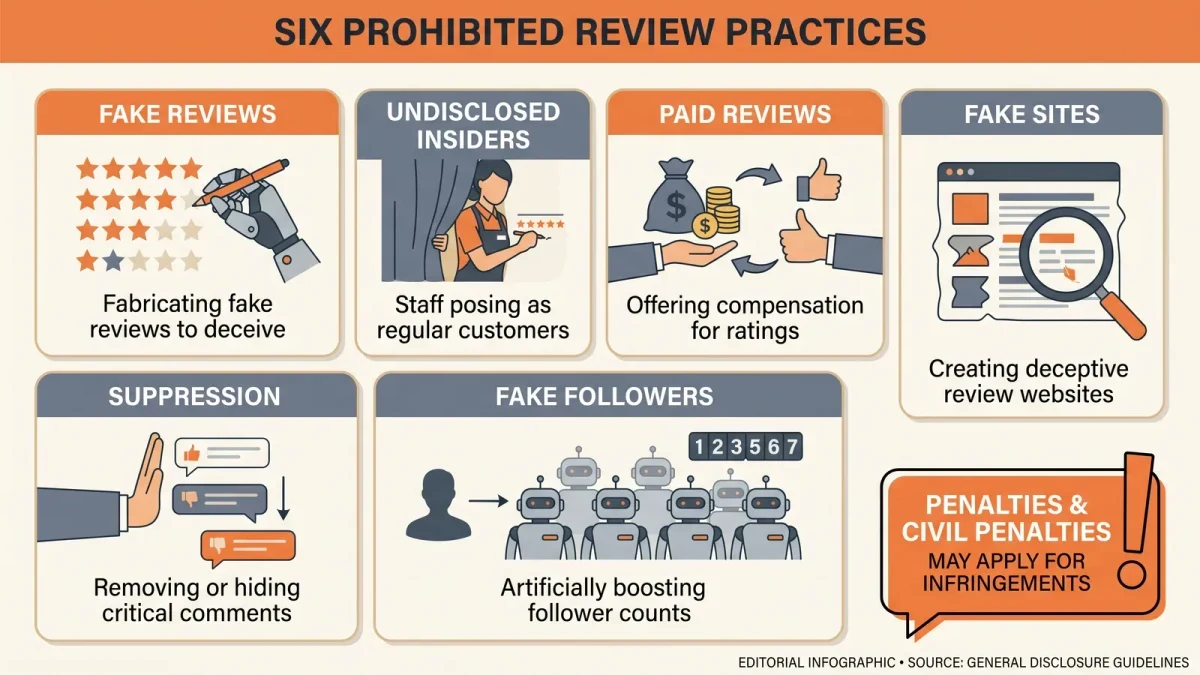
The Consumer Review Rule prohibits a specific list of practices that until recently lived in a gray zone:
- fake or AI-generated reviews and testimonials that misrepresent a reviewer's real experience
- buying positive reviews or suppressing negative ones
- insider reviews — from employees or owners — posted without disclosure
- fake social media indicators, including purchased followers and engagement
- review-gating and misusing a "review suppression" service
Before the rule, most of this was prosecutable only as general deception under Section 5. The rule makes the practices independently illegal and lets the FTC seek civil penalties — adjusted annually, roughly $50,000-plus per violation. marketing news.
The per-violation arithmetic is what turns a compliance topic into a finance topic. A reputation vendor posting a few hundred incentivized reviews is not generating a few hundred dollars of exposure; at statutory rates it is generating exposure counted in the millions. Boards have noticed. The practical consequence is that review hygiene has migrated from the marketing team's discretion to the legal department's audit list, and budgets follow that migration.
Why warning letters matter
Warning letters are not penalties. They are notice. Once a company receives one, the FTC's standard argument in a later case shifts: continued violations are no longer innocent mistakes, they are knowing ones. The ten recipients now sit at the front of the enforcement queue, and any business running the same playbook is effectively on notice too — the letters were published.
The move ends what enforcement lawyers described as the agency's education phase. In 2024 and most of 2025, the FTC's consumer review activity was guidance and rulemaking housekeeping. December 2025 is where the paper becomes process.
Notice also travels downstream. The letters went to companies, but the conduct they describe is usually purchased — from agencies, reputation vendors and freelance marketplaces that sold "review improvement" as a service. Every one of those sellers now has clients who can produce the invoices, and a defendant facing penalties has a strong incentive to point at the vendor who proposed the playbook. Expect the supply side of the fake-review economy to become the richer enforcement target precisely because it multiplies violations across many customers.
The notice economy
Published warning letters do something complaints cannot: they convert private counsel into public benchmarking. Every brand can now read what the ten recipients were told, compare its own practices against the described conduct, and act without waiting for its own letter. In effect the FTC outsourced the first round of enforcement to the market — competitors, class-action lawyers, platform policy teams and insurers all read the same documents, and each acts on its own timeline. Consumer class actions frequently follow agency notices of exactly this kind, which means the regulatory cost of fake reviews is only the floor.
Where the industry actually is
Most marketing teams have already cleaned up obvious fake-review behavior. The exposure now concentrates in three places: agencies that still guarantee review volume, vendors selling "reputation packages" that quietly include incentivized reviews, and brands whose overseas marketing partners post reviews nobody in headquarters has inspected. AI-generated testimonials — a review of a product written by a model that never used it — are explicitly covered, and they are the fastest-growing category of the problem.
The AI angle deserves specific attention because it inverts the usual economics of review fraud. Faking reviews used to require people — slow, expensive, traceable through payment rails. A language model removes all three constraints, which is why fabricated testimonial volume has grown faster than detection. But the rule does not care whether a fake review was written by a human or generated: misrepresenting a reviewer's real experience is the violation. The cheapness of the tooling changes the scale of exposure without changing the law at all.
The affiliate and partner channel is the second quiet exposure. Brands are responsible for what their partners post about their products, and partner networks operate on incentive structures — commissions, bonuses for conversion — that look exactly like the incentivized-review arrangements the rule names. A distribution agreement that rewards partners for enthusiasm without disclosure rules is a liability document now, not just a commercial one.
For PR and marketing professionals, the practical reading is narrow and uncomfortable: if a client asks you to "improve their review profile," the answer is no longer an ethics question. It is a legal one, with a published rule and a documented enforcement trail behind it.
What to do this quarter
- Audit every review-acquisition process, including vendor contracts that promise outcomes
- Check that insider and employee reviews are disclosed or removed
- Kill any engagement-buying — followers, likes, comments — on social accounts
- Document your cleanup; a paper trail of compliance is what separates a warning letter from a complaint
One addition to that list: put the review question in onboarding. New clients and new vendors should be asked, in writing, whether any of their current review profile was incentivized, purchased or machine-generated. The answer creates a record; the absence of the question creates joint exposure.
The ten companies that received letters in December did not get fines. The next batch may not be so lucky.