The pitch lands in a founder's inbox on a Tuesday morning. "Guaranteed publication in Forbes. 30-day delivery. As seen on the cover." The price is $14,500. The sender has a LinkedIn profile, a website with a client wall of famous logos, and a calendar link. What the founder is actually buying, in most cases, is a placement in a site that looks like Forbes at a glance, ranks for nothing, and is owned by the same company that owns the "editorial agency" sending the invoice.
This is the guaranteed-placement economy, and it runs on one asymmetry: founders cannot easily tell the difference between a media brand and a media brand costume.
The clone anatomy
Forbes does not sell coverage. Its own contributor framework has been tightened repeatedly precisely because intermediaries marketed contributor slots as "Forbes features." The legitimate paths into a top-tier business publication are pitched, earned, and edited — and no employee or freelancer can lawfully promise one for a fee. scam coverage.
So the operators of guaranteed-placement schemes rarely try to place anything in the real publication. Instead they assemble or rent one of these assets:
- Cloned or lookalike mastheads. Domains with near-identical names, borrowed design language, and a byline system that mimics the real outlet. The client receives a URL that reads convincingly in an email signature.
- Paid "councils" and contributor programs. Genuine pay-to-publish programs where membership includes publishing rights. Resellers repackage a $500–$1,000 membership as a $10,000+ "guaranteed feature," pocketing the margin.
- Expired-domain newsrooms. A shut-down regional paper's domain, repopulated with generic press releases. The pitch calls it "syndication across 400 outlets" — many of which are the same five sites with different skins.
The money trail is the tell. In a legitimate PR engagement, fees buy labor: research, pitching, relationship work. In the clone scheme, the fee mostly buys the reseller's margin. Investigators and industry post-mortems of these operations consistently show the same cost stack: a few hundred dollars for the domain or membership, a few hundred more for a freelancer to ghostwrite the piece, and 80–95% gross margin on the invoice.
What "guaranteed" actually guarantees
A guarantee is only as good as the asset behind it. The deliverable in these deals is technically real: a live URL, a published article, sometimes a PDF proof sheet. But the asset carries none of the properties the client believes they bought:
- No readership. Traffic data on clone domains is negligible or bought. "Reach" figures in the deck are invented or aggregated across the operator's own network.
- No editorial value. Search engines classify many of these sites as low-quality or spam. The article can be deindexed within months.
- No social proof that survives scrutiny. When a journalist, investor, or procurement officer checks the URL, the costume comes off in about ninety seconds.
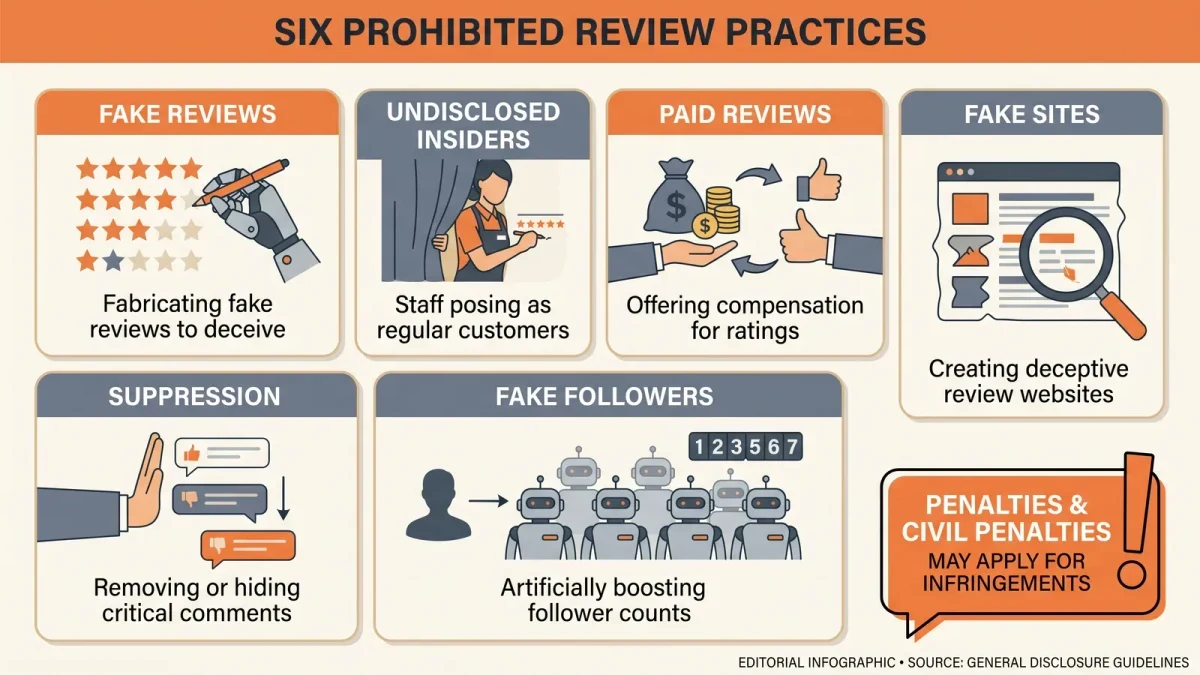
The Federal Trade Commission's 2024 rule on fake reviews and testimonials (16 CFR Part 465) and its updated Endorsement Guides target the demand side of this economy too: paying for coverage and then presenting it as earned, unpaid editorial recognition can constitute a deceptive practice. The rule's ban on selling or purchasing fake indicators of social influence reached e-commerce first, but regulators have made clear that manufactured credibility of any kind is in scope.
The pitch funnel, reconstructed
- Prospecting. Founders who recently raised funding or launched a product — public data — get cold outreach. "We noticed your Series A" is flattery calibrated to a funding announcement.
- The logo wall. The agency's site displays recognizable brands. Probing usually reveals the logos belong to one-time clients of a founder's former employer, or are used without permission.
- The proof drop. The prospect receives three or four links to "recent features." Each link resolves to a clone-domain or paid-council article. The real publication's name appears only in typography, never in the domain.
- Deadline pressure and the guarantee. "Editorial slots close Friday." The guarantee — the word itself — is the closing device. Nothing earned and editorial is ever guaranteed.
- Delivery and the second sale. After delivery, the same list is resold. Founders report being approached months later by a "syndication partner" of the same operator.
Where this crosses into fraud
Not every sloppy placement agency is a criminal enterprise. The line is misrepresentation: charging for "publication in [real outlet]" while delivering a lookalike domain is a false statement of the deliverable itself. That is the fact pattern regulators and civil litigators act on. Operators have faced FTC scrutiny under deception authority, and civil suits by defrauded clients have turned on the same question: what was on the invoice versus what was on the wire. When multiple victims describe the same invoice language, the pattern becomes documentable rather than alleged.
How to protect yourself
- Check the domain, not the design. Every promised placement must be named as an exact URL before payment. "Forbes" means forbes.com. Nothing else.
- Verify the publication accepts payment. If a real outlet prohibits paid placements in its masthead or policies, any "guarantee" involving it is false on its face.
- Ask who owns the delivering site. A WHOIS lookup costs nothing. Recent registration, privacy-shielded ownership, or a registrant matching the agency itself ends the conversation.
- Ask for traffic evidence from a third-party tool. Not screenshots — live reader access or a screen-shared session in an analytics tool you choose.
- Refuse the word "guaranteed" in editorial. Legitimate publicists promise process and effort, never outcomes at named outlets.
- Put the deliverable URL list in the contract. With a refund clause per missed URL.
- Check FTC and court records before wiring. Operator names, agency names, and sender domains are searchable in FTC case files and CourtListener dockets.
- Report it. A complaint to reportfraud.ftc.gov creates the record the next victim — and the next case — will need.
The founders who lose the most in this scheme are not the ones who cannot afford $14,500. They are the ones who can, and who then put the clone link in an investor data room. Credibility bought from a costume does not survive a second reader. It barely survives the first.