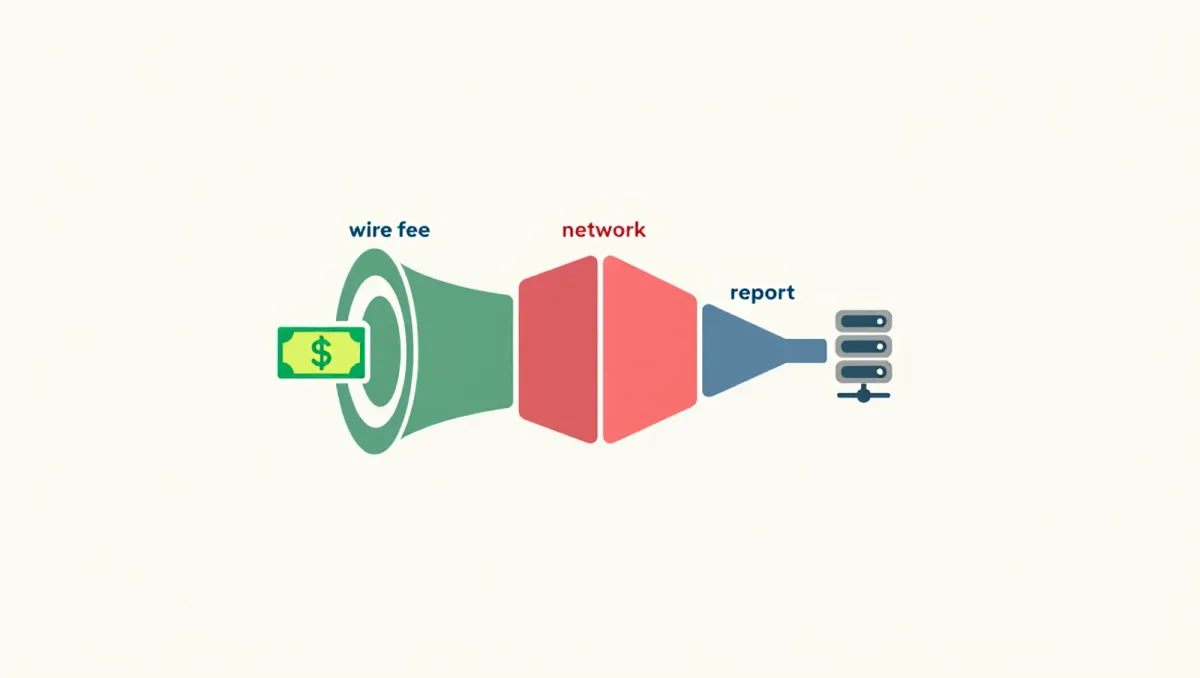
Wire services were once boring, regulated utilities. You paid a fee, your press release went out over a recognized network, and you received a wire receipt naming the actual distribution. That boring legitimacy is precisely what scammers copy. A fake wire service has a professional name, a .com domain, a pricing page, and one crucial difference: nothing is ever distributed anywhere except to the client's own inbox.
The legitimate model, briefly
Recognized newswire services charge for genuine distribution: your release reaches journalists, databases, and publication partner sites, and you can verify pickup. Legitimate services disclose their networks, publish partner lists, and issue itemized receipts. Costs run from a few hundred dollars for basic distribution to several thousand for premium tiers with targeted outreach.
The fake version inverts every verifiable element while keeping the surface intact.
How the fake version is built
Documented patterns across victim reports and civil complaints follow a consistent build:
- The shell. A name that borrows credibility: "NewsWire Distribution Group," "Global Press Wire Services." A website with logos of real partner outlets — displayed without permission.
- The price anchor. Undercutting real wires by 20–40%. A $395 "national distribution" package is cheap enough to feel like a find and too cheap to be real: actual network distribution costs more to provide than to sell.
- The fake proof. After payment, the client receives a "distribution report": hundreds of URLs. Sampled systematically, the URLs resolve to a small set of recently registered domains, parked pages, or PDFs hosted on the vendor's own server. The "500 outlets" are frequently one WordPress install with thirty category pages.
- The paper trail that isn't. Real wires issue receipts tied to a distribution ID traceable to the network. Fake services issue branded PDFs that reference nothing external.
The variant that harms journalists too
A second fake-wire pattern attacks the other side of the market. Operators pose as newswire staff and sell journalists "early access" to embargoed releases for a subscription fee, or sell PR professionals "guaranteed journalist delivery" that consists of scraped, outdated media lists. Both trades monetize a directory that is either stolen, expired, or fabricated. Verified newsroom impersonation is a straightforward wire-fraud fact pattern: the sender claims to be an institution it is not, in exchange for money. That distinction — impersonation for payment — is what separates a scam from a merely bad vendor, and it is why FBI complaint data on business email compromise extends to brand impersonation of media institutions.
Cost of a fake pickup, cost of a real one
| Item | Fake service | Legitimate service |
|---|---|---|
| National wire distribution | $195–$495 (margins near 100%) | $400–$1,000+ depending on tier |
| Pickup evidence | Vendor-hosted PDFs and clone URLs | Traceable distribution ID, partner-site links |
| Journalist reach | None, or scraped stale lists | Opt-in newsroom feeds and databases |
| Refund behavior | Ghosting or "re-run" offers | Defined service-level terms |
The pricing itself is a diagnostic. A wire that charges less than the cost of operating a network cannot be operating a network.
Where the scheme shows up in records
Fake distribution services surface in FTC complaints under deceptive-marketing authority, and in state consumer-protection actions. Because each individual loss is often under the threshold that triggers litigation, the schemes persist — which is why complaint databases matter. Each report at reportfraud.ftc.gov is a data point regulators aggregate into cases.
A delivery, sampled
One reconstruction shows the method's value. A client paid $295 for "distribution to 400+ outlets" and received a 40-page report. Sampling ten URLs at random: two resolved to a shared news-theme template on domains registered the same week; three were PDF attachments on the vendor's own hosting; two were pages on a site whose WHOIS listed the vendor's own address; one redirected to a parked domain; two loaded but showed zero organic traffic in any third-party tool. The full report, sampled properly, described fewer real readers than a mid-sized church newsletter. The receipt's "distribution ID" matched no external registry — because none exists outside the vendor's document template. Nothing about this requires forensic skill: it requires ten random samples and two free tools. The same sampling discipline, applied before payment to the vendor's "sample reports," ends the conversation on day one. Vendors who refuse pre-sale sampling of prior clients' reports have answered the question the sampling would have asked.
Why the cheap price is the confession
Pricing deserves a second look because it is the most reliable single diagnostic. Operating a genuine distribution network — partner feeds, newsroom opt-ins, database placements — carries real per-release costs: transmission, hosting, partner agreements, support. A vendor selling below that floor is not efficient; the product is simply absent, and the missing cost is exactly the part of the service you assumed you were buying. The arithmetic generalizes across the whole scam economy: in every variant documented here, the invoice price sits below the verifiable cost of the promised deliverable. Sellers count on buyers reading price as generosity rather than as information. Train the reflex once — cost the deliverable, compare the quote, subtract — and the fake-wire pitch, like its cousins, fails before the first wire transfer.
How to protect yourself
- Ask for the distribution network before paying. Real wires can name their network and partners. Hesitation, NDAs about "partner lists," or a slide of famous outlet logos is your answer.
- Verify the company entity. State registration, a real address, and a few years of history. Many fake wires are months old with privacy-shielded ownership.
- Demand a traceable receipt. A distribution ID you can independently verify — not a branded PDF.
- Sample the report URLs. Check ten at random: domain age via WHOIS, traffic via a third-party SEO tool, and whether they are the same site re-skinned.
- Price-test against real wires. If the quote is dramatically below the known cost of genuine distribution, the product does not exist.
- Never pay journalists for "access." Embargoed material is not sold by legitimate wires, and paying for it marks you as a target.
- Report losses. File with the FTC and, where impersonation is involved, the FBI's IC3.
A wire service is a logistics business. If you cannot trace what moved, through which channels, to which endpoints — nothing moved, and the only thing distributed was your payment.